
The market for management system certification is complex, multilayered and often unintuitive for organizations.
ISO standards, industry schemes, private frameworks, differences in accreditation all of these elements make certification communication difficult to understand, even for experienced professionals.
It is within this landscape that the term misstandarding emerges.
It describes a practice increasingly observed on the global market, yet one that has lacked a clear, unified name — until now.
Because of its impact on transparency and trust, the concept requires precise explanation.
What is Misstandarding?
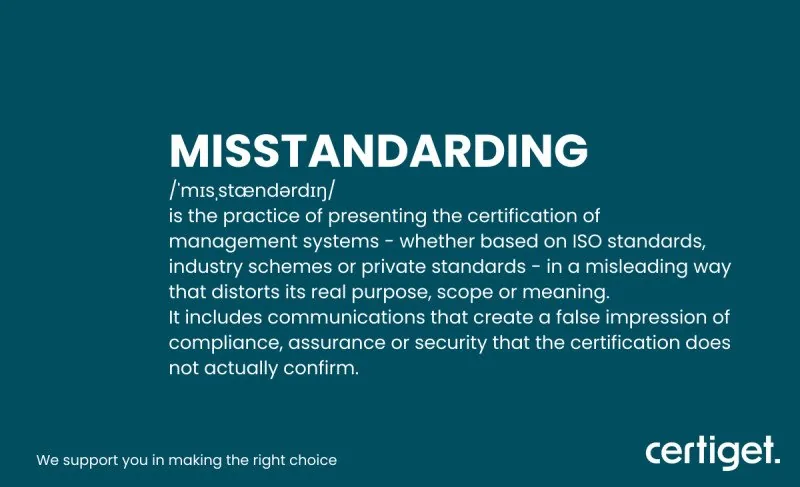
Misstandarding refers to the inaccurate, unclear or misleading presentation of management system certification — whether it relates to:
- ISO standards,
- industry schemes (e.g. BRCGS),
- private certification programs,
- conformity assessments performed by independent verifiers.
It includes any type of communication that:
- overstates the meaning of a certificate,
- falsely implies a guarantee,
- assigns a scope that the certification does not cover,
- creates the impression of full security, compliance or responsibility,
- shifts accountability from the organization to the standard itself.
Misstandarding is not always intentional.
It often results from lack of knowledge, communication shortcuts or simplified messaging that has become widespread over time — even when such claims contradict the intent of standards and accreditation rules.
Examples of Misstandarding
1. Presenting ISO/IEC 27001 certification as a “guarantee of cybersecurity”
The standard provides a management framework — it is not a guarantee that incidents will not occur.
2. Claiming that “the company is legally compliant because it holds ISO 9001”
ISO 9001 confirms the functioning of a quality management system, not legal compliance.
3. Using the certification body’s logo in relation to processes not covered by the scope
Example: certified production → marketing suggesting certified logistics.
4. Suggesting that an auditor has “approved” a product or service
Certification auditors do not approve products — they confirm that a system operates as required.
5. Implying that an industry scheme guarantees full compliance with legal requirements
Industry standards support compliance but do not replace legal obligations.
Why Is Misstandarding Dangerous?
1. It misleads customers and consumers
Incorrect communication creates a false sense of security and may result in poor decisions.
2. It damages the credibility of certification bodies
If certificates are presented as “guarantees,” trust in the certification ecosystem erodes.
3. It disadvantages companies that communicate responsibly
Organizations that follow the rules face unfair competition from those that exaggerate claims.
4. It creates information chaos
Misstandarding blurs the lines between certification, auditing and conformity assessment.
5. It may result in legal risk
Misleading communication can be classified as false or deceptive advertising.
Why Misstandarding Matters for the Market
Misstandarding undermines the very foundation of management system certification — trust.
Certification is meant to:
- build transparency,
- demonstrate responsibility,
- confirm consistency and quality.
When communication becomes inaccurate, certificates lose their value as evidence of conformity.
For this reason, the market needs:
- clear terminology,
- better education,
- higher communication standards,
- structured support for organizations in presenting certification correctly.
The term misstandarding gives the industry a precise vocabulary to describe a problem that has long existed but never had an established name.
The Role of Certiget in Addressing Misstandarding
As a platform supporting organizations in choosing the right certification body, Certiget:
- promotes accurate and transparent communication regarding standards,
- educates companies on correct scope presentation,
- explains differences between certification, verification and internal audits,
- popularizes knowledge about accreditation and its importance,
- provides tools to compare certification bodies in a transparent, structured way.
Misstandarding is one of the issues Certiget continuously monitors and addresses — both through analyses and educational content.
Conclusion
Misstandarding has been present in the certification market for years, but only now receives a name that captures its essence.
Understanding this phenomenon is crucial for:
- a trustworthy certification ecosystem,
- responsible marketing communication,
- informed decision-making,
- protecting the reputation of certification bodies,
- maintaining the real value of management system certifications based on ISO standards and industry schemes.
By naming the problem, we take the first step toward solving it.
That is why misstandarding matters.
-avatar.webp)