Training, professional experience and independent competence certification are important elements of professional development. For management system auditors, consultants and specialists, demonstrating competence has become increasingly important alongside acquiring knowledge and practical skills.
Accredited personnel certification under ISO/IEC 17024 provides a structured way to demonstrate that individuals meet defined professional competence requirements.
How does personnel certification differ from completing a training course? What does the certification process involve, and how can professionals maintain their credentials over time?
What is ISO/IEC 17024?
ISO/IEC 17024 is an international standard establishing requirements for bodies operating personnel certification schemes.
It aims to ensure that competence assessment is conducted consistently, impartially and reliably. The standard covers certification scheme development, candidate assessment, examinations, certification decisions, surveillance and recertification.
On 31 March 2026, ISO/IEC 17024:2026 replaced the 2012 edition. The revision introduces updated requirements, including provisions concerning artificial intelligence used in certification processes.
Although personnel certification applies to numerous industries, it is particularly relevant to management system professionals, including auditors, lead implementers, quality managers and information security specialists.
What is accredited personnel certification?
Personnel certification is a process through which an independent certification body confirms that an individual meets the competence requirements of a defined certification scheme.
Accreditation provides an additional level of assurance by confirming that the certification body is competent to conduct the relevant certification activities.
Three distinct roles are involved:
- Accreditation body: assesses and accredits personnel certification bodies against applicable requirements, including ISO/IEC 17024.
- Personnel certification body: assesses candidates and makes certification decisions under defined certification schemes.
- Certified professional: demonstrates competence and receives a credential after successfully meeting the scheme requirements.
Accreditation bodies include the Polish Centre for Accreditation (PCA), United Kingdom Accreditation Service (UKAS) and ANSI National Accreditation Board (ANAB).
Importantly, accreditation applies to specific certification activities and schemes. It does not automatically cover every training programme, examination or credential offered by the same organisation.
Training certificate versus professional competence certification
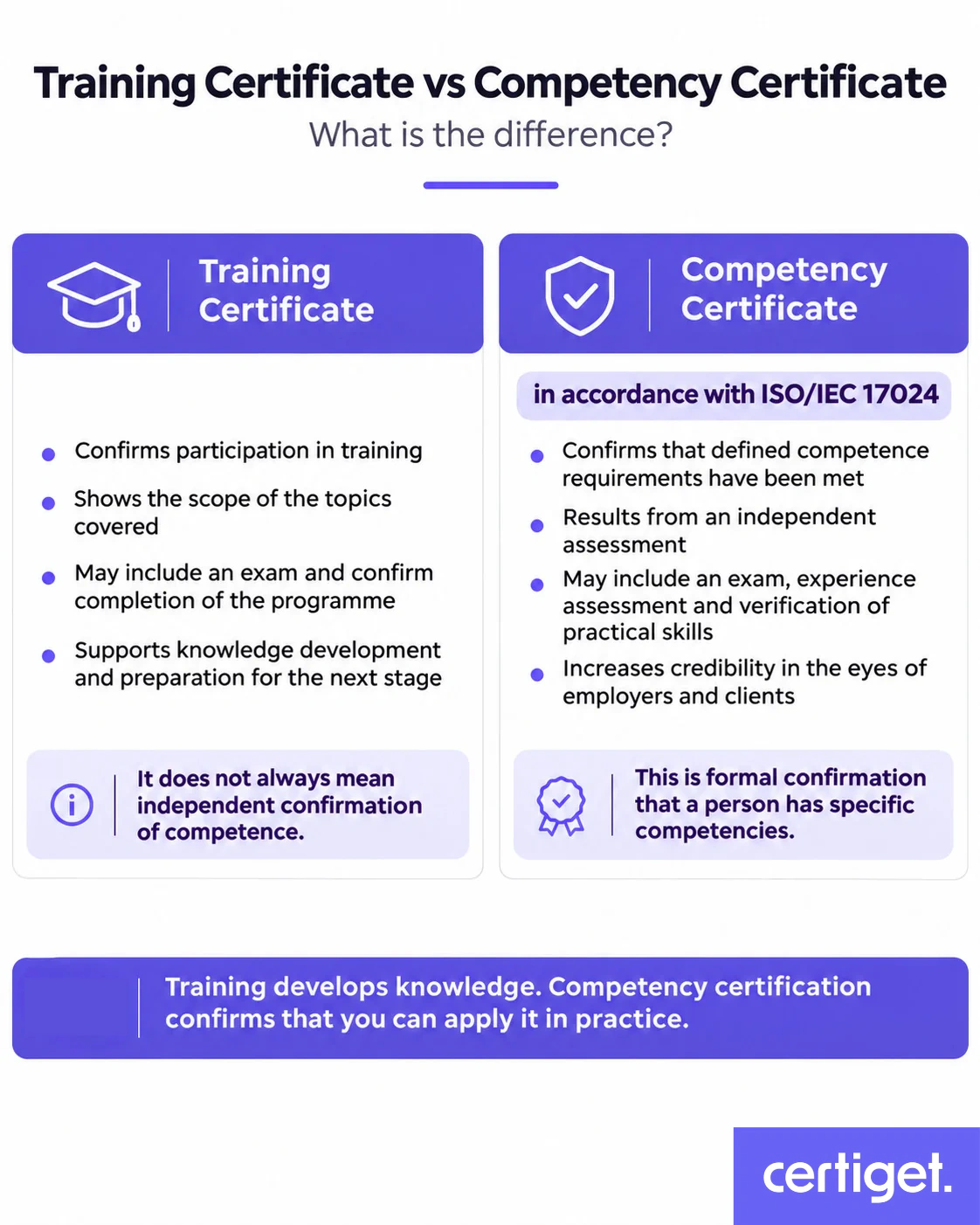
Completing an ISO training course may result in a certificate of attendance, completion or achievement.
Professional certification under an accredited ISO/IEC 17024 scheme goes further by confirming that an individual has successfully demonstrated the competence defined by that scheme.
For example, an ISO/IEC 27001 Lead Auditor training course may develop knowledge and practical auditing skills. Obtaining the corresponding professional certification may additionally require documented professional experience, auditing practice and successful assessment.
Training can support professional certification, but course completion does not automatically result in an accredited personnel certification credential.
Why pursue accredited professional certification?
Professional certification can provide independent evidence of competence and increase confidence among employers, clients and business partners.
For management system auditors and consultants, recognised credentials may support professional credibility when conducting audits, implementing management systems, delivering consultancy services or applying for international projects.
Certification may also help organisations evaluate the competence of personnel undertaking specialised responsibilities.
In certain circumstances, specific professional certifications can form part of legal requirements, contractual conditions or procurement eligibility criteria.
Another important benefit is continued professional development. Certification schemes frequently require professionals to maintain their knowledge, document relevant experience and periodically demonstrate that they continue to meet defined competence requirements.
Professional certification should therefore be viewed not only as an achievement, but also as part of an ongoing development process.
Personnel certification in practice – NIS2 and cybersecurity
European cybersecurity legislation provides a practical example of the growing importance of documented professional competence.
Directive (EU) 2022/2555 (NIS2) requires Member States to ensure that management bodies of essential and important entities receive cybersecurity training. Cybersecurity awareness and training are also included among the measures required for managing cybersecurity risks.
However, NIS2 does not establish a universal obligation to hold an ISO/IEC 17024 personnel certification.
National legislation may specify additional competence and qualification requirements.
Poland – the National Cybersecurity System Act, amended in 2026 to implement NIS2, introduces annual documented cybersecurity training requirements for specified management roles. Polish legislation also recognises certain professional certifications as a means of demonstrating the qualifications required for statutory cybersecurity audits. These include ISO/IEC 27001 and ISO 22301 Lead Auditor credentials issued by appropriately accredited personnel certification bodies. This certification-based pathway has existed since 2018 and remains available under the amended Act. Article 15(2) also recognises alternative pathways based on professional experience.
Slovakia – national cybersecurity legislation requires specified cybersecurity audits to be performed by certified cybersecurity auditors. Under § 29(3), certification is carried out by a public-sector body accredited to certify persons in cybersecurity. The law cites STN EN ISO/IEC 17024 as an example in footnote 31b.
These examples demonstrate the practical value of independently assessed professional competence. However, certification requirements vary between countries, professional roles and regulatory activities.
Who provides accredited personnel certification?
Both management system certification bodies and organisations specialising in professional certification operate accredited personnel certification schemes.
Examples include:
-
TÜV NORD Polska (Poland) – accredited by the Polish Centre for Accreditation (PCA), accreditation No. AC 118. The scope includes certification of ISO 50001 Energy Management System Lead Auditors, ISO/IEC 27001 Information Security Management System Lead Auditors and ISO 22301 Business Continuity Management System Lead Auditors.
-
DEKRA Certification (Poland) – accredited by the Polish Centre for Accreditation (PCA), accreditation No. AC 178. The scope includes certification of ISO/IEC 27001 Information Security Management System Lead Auditors.
-
PECB (Canada / International) – accredited by the United Kingdom Accreditation Service (UKAS), accreditation No. 21923. The scope includes Lead Auditor and Lead Implementer certification schemes for ISO/IEC 27001 Information Security Management Systems, ISO 9001 Quality Management Systems and ISO/IEC 42001 Artificial Intelligence Management Systems. The current UKAS schedule for PECB still lists ISO/IEC 17024:2012 as the accreditation basis.
Organisations such as TÜV NORD Polska and DEKRA operate in management system certification while also providing accredited personnel certification within defined scopes.
PECB focuses on professional competence certification, with training delivered through its international partner network.
Other organisations, including management system certification bodies such as BSI and specialised training providers, offer courses for auditors and management system professionals, including programmes with external recognition.
When choosing a programme, candidates should identify the organisation responsible for personnel certification and verify that the specific certification scheme falls within its accreditation scope.
How can you obtain ISO/IEC 17024 personnel certification?
The certification pathway depends on the chosen professional credential. It generally involves:
- Selecting a certification scheme relevant to your career goals, such as ISO 9001 Lead Auditor, ISO/IEC 27001 Lead Auditor or ISO 50001 Energy Management System Lead Auditor.
- Checking eligibility requirements, including education, professional experience and practical auditing or implementation experience.
- Preparing for competence assessment through self-study, professional training and practical exercises.
- Completing the certification process, including submitting evidence and passing the required examination or assessment.
- Receiving a certification decision confirming whether the scheme requirements have been met.
Some certification schemes allow candidates to take an examination without completing a prescribed training course. Others may require specific educational preparation or previous professional experience.
Several organisations also provide different certification levels, allowing professionals to progress towards more advanced credentials as their experience develops.
How long is personnel certification valid?
Professional certification does not necessarily remain valid indefinitely.
ISO/IEC 17024 provides a framework for reassessing competence, while the detailed validity periods and recertification requirements are defined by individual certification schemes.
For example, TÜV NORD Polska issues personnel certificates valid for three years. Its auditor recertification requirements include evidence of professional auditing activity, such as at least one audit annually or four audits during the certification period.
PECB also operates a three-year certification cycle. Depending on the credential, certificate holders must document Continuing Professional Development (CPD), comply with the relevant code of ethics and meet applicable maintenance fee requirements.
Recertification may involve documented professional activity, additional training, continuing competence assessment or another examination.
Before applying, candidates should review not only the initial certification requirements and fees, but also the full conditions for maintaining and renewing their credential.
Where can you find training that supports professional certification?
Choosing an appropriate training course begins with identifying the knowledge and skills required for your intended professional role.
An ISO 9001 Internal Auditor, an ISO/IEC 27001 Lead Auditor and an ISO 50001 Energy Management System specialist will typically require different training pathways and levels of experience.
The Certiget Training Catalogue enables users to explore and compare management system training programmes offered by different providers.
Available filters help users narrow down courses by standard, training type, provider type, individual provider, programme recognition, certificate awarded, schedule, delivery format and price.
This makes it easier to compare courses for auditors, lead auditors, management system representatives and professionals responsible for implementing management systems.
Candidates planning to obtain accredited professional certification should also verify whether a training programme is linked to an ISO/IEC 17024 personnel certification scheme and confirm the certification body's current accreditation scope.
By combining training, practical experience, independent assessment and ongoing professional development, individuals can build a structured pathway towards recognised professional competence.
Browse ISO/IEC 27001 training courses.
Develop your skills and demonstrate your competence
Accredited personnel certification provides a recognised mechanism for independently assessing professional competence.
For management system specialists, it can support professional credibility, access to particular projects and a structured approach to continuous development.
Find and compare ISO training courses on Certiget – explore training providers, programmes and professional development opportunities.
Develop your professional skills
Find and compare training coursesReferences
- ISO – ISO/IEC 17024:2026
- PCA – Accredited Personnel Certification Bodies
- PCA – TÜV NORD Polska (AC 118)
- PCA – DEKRA Certification (AC 178)
- UKAS – PECB Accreditation Scope
- TÜV NORD Polska – Personnel Certification
- PECB – Certification Process
- PECB – Certification Maintenance Policy
- Directive (EU) 2022/2555 – NIS2
- Polish National Cybersecurity System Act – 2026 Amendment
- Polish Regulation on Cybersecurity Audit Certificates
- Slovak Cybersecurity Act No. 69/2018