Internal auditor or lead auditor? If you are starting to develop your auditing skills, ‘lead auditor’ may sound like a more experienced auditor with higher qualifications and wider authority. Is that really what the term means?
The two terms describe different aspects of management system auditing. The distinction matters when choosing a course and planning your career.
What is an internal auditor?
An internal auditor conducts first-party audits on behalf of the organisation whose management system is being assessed.
The auditor gathers and evaluates evidence to determine how far the organisation meets the audit criteria, which may include the requirements of ISO 9001, ISO 14001 or ISO/IEC 27001.
Internal auditors need competence appropriate to the scope of the audit, knowledge of the applicable criteria, and the ability to remain objective and impartial.
A specific training certificate is generally optional. The organisation may set its own qualification requirements, such as completing a course or gaining audit experience.
Our guide on how to become a management systems auditor explains the requirements and first steps in more detail.
What is a lead auditor?
A lead auditor heads the audit team and coordinates the audit.
Their tasks may include planning the audit, assigning work to team members, coordinating communication with the auditee, overseeing findings and presenting the results.
A lead auditor can head an internal audit when its scope and organisation call for someone to lead the team. The role also exists in external audits.
Completing a Lead Auditor course alone does not qualify someone to carry out certification audits on behalf of a certification body.
Internal auditor and lead auditor roles compared
| Criterion | Internal auditor | Lead auditor |
|---|---|---|
| What does the title describe? | The type of audit they conduct | Their role in the audit team |
| Main responsibility | Assessing conformity against audit criteria | Leading and coordinating the audit |
| Where do they work? | Internal audits | Internal and external audits |
| Do they have to lead a team? | No | Yes, when a team has been appointed |
| Does completing a course qualify them on its own? | No | No |
The two titles describe different aspects of audit work. There is no formal progression from one to the other. ‘Internal auditor’ identifies the type of audit, while ‘lead auditor’ identifies who leads it. The same person can conduct an internal audit and lead its audit team.
Why is Lead Auditor training seen as more advanced?
One reason is the way the auditor training market developed. Five-day Lead Auditor courses became widely recognised, including programmes certified by CQI and IRCA.
Completing one of these courses can contribute to a certification body’s assessment of an auditor’s competence. Each body sets its own criteria, and a CQI and IRCA certified course is not a universal requirement.
Certification bodies may use different routes to qualify auditors. They may consider education, professional experience, knowledge of the applicable standards, auditing skills, completed training and the results of observing and assessing the auditor’s work.
Even completing a recognised Lead Auditor course does not automatically qualify someone to conduct certification audits.
The certification body is responsible for assessing and confirming the auditor’s competence for the scope in which it intends to appoint them.
Should you start with a Lead Auditor course? My experience
I learnt the importance of preparation when I attended my first Lead Auditor course, run by SGS.
It was a five-day residential course, and I arrived without a solid understanding of the standard’s requirements.
The programme was intensive. Classes started in the morning, and group work afterwards sometimes continued until late in the evening.
That meant extra work for me. When the other participants had finished for the day, I often kept studying the standard, trying to understand requirements they already knew well.
Completing the course took considerably more work than I had expected.
Looking back, a better understanding of the standard beforehand would have let me focus more on audit techniques, practical exercises and learning from the other participants.
If you are starting out and are unfamiliar with the standard, I recommend learning the basics of the management system before taking an auditor training course.
Beginners can still consider a Lead Auditor course. Check the prerequisites for the particular programme and prepare accordingly.
Łukasz Kowalski, Managing Director, Certiget
Which course should you choose?
The choice depends on what you already know and what you want to do next.
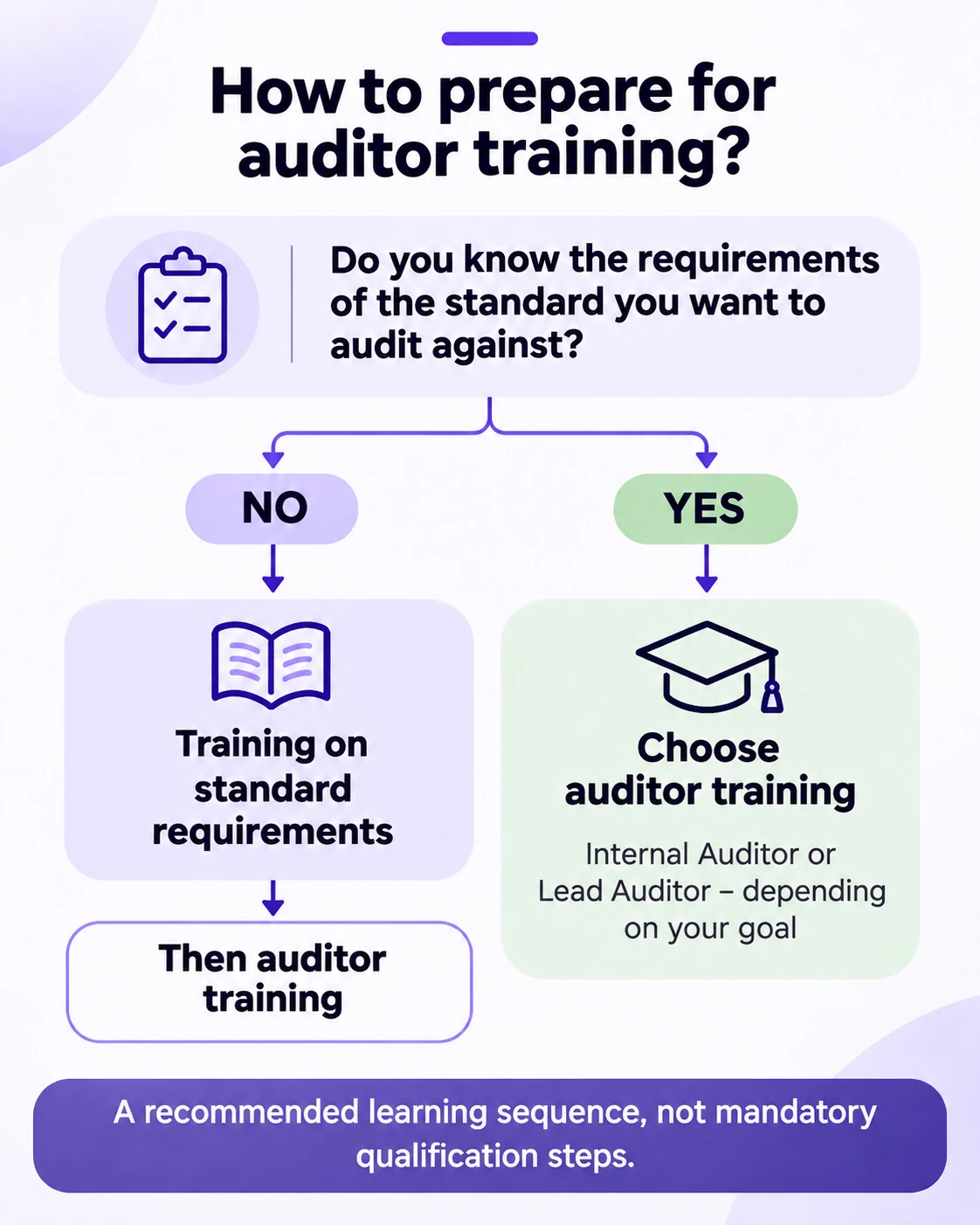
If the standard is new to you, start with a course on interpreting and applying its requirements. That will help you make sense of the audit exercises later.
If you know the requirements and have little or no auditing experience, consider internal auditor training. It covers audit methods, gathering evidence and formulating findings.
If you plan to lead audit teams or work for a certification body, a Lead Auditor course may suit your goals. Before enrolling, check the prerequisites, course content and qualification criteria of the organisation you intend to work with.
The right route varies from person to person. Someone with substantial industry experience and a good knowledge of the standard may be ready for an intensive Lead Auditor course without having taken an internal auditor course first.
Compare auditor training courses on Certiget
Alongside price and duration, compare course content, prerequisites, tutor experience and the document you receive on completion.
Use the Certiget training catalogue to compare courses from different providers and find one that fits your needs.
Summary
An internal auditor conducts audits on behalf of an organisation. A lead auditor leads the audit team. One person can do both.
When choosing a course, look beyond the title and how well known the programme is. Match the level and content to what you already know and the role you want to take on.
Understand the standard’s requirements first, then learn how to audit against them. This sequence can help you get more out of your training and develop the skills you need.